The house had shingles.
Whether it also had structural integrity was up for debate—and in this family, everything was up for debate.
What the house looked like depended on who you asked, which was unfortunate, because everyone had an opinion—each louder than the one before it. No one had really listened—not since 1998, before inflation outpaced empathy, before Grandpa died and no one could agree on who hurt first or worst. Not since the money dried up, the cheating got complicated, and every conversation collapsed into bootstraps versus bailouts.
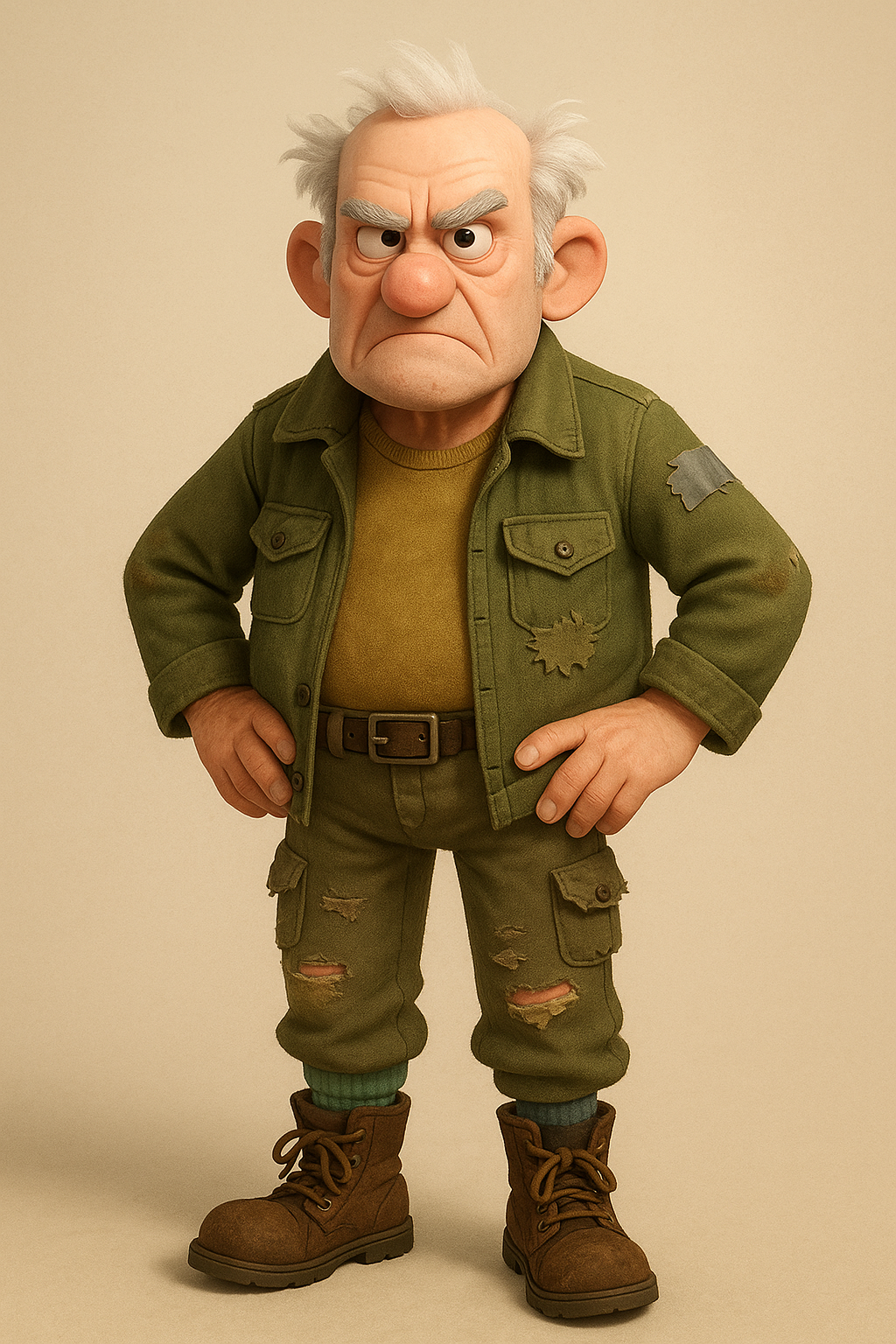
Garrison, who hadn’t updated his worldview since the Vietnam War, saw the house as a bunker. Tarped windows. Excellent escape routes in case the government made their move on his mashed potatoes. He wore the same army surplus jacket he’d had since Vietnam, held together by duct tape and stubbornness. His cargo pants were tattered to bits—but he’d argue, “still better than anything made in China.” He blamed China for everything from jobs to the weather, never quite connecting that it wasn’t communism but capitalism that sold the factory keys. His socks were mismatched. His grip on reality, also mismatched.
Lottie, who smelled like eucalyptus, called the house a “chakra-safe yurt space.” Barefoot and humming what may have been the jingle from a probiotic Greek yogurt commercial, she stepped out of her pastel van, Enya’s early jams blaring behind. “The home’s aura feels congested,” she commented, laying hands on the front steps.
Preston Hale III, in a blazer that cost more than most people’s monthly rent and about as much moral detachment, glanced up from his Hermes Apple Watch. “Looks… fine. He mentioned on the state of the house, Is there Wi-Fi?” His shoes were Italian. His socks were cashmere and smug. What he saw in the house was asset depreciation, between notifications from three group chats.
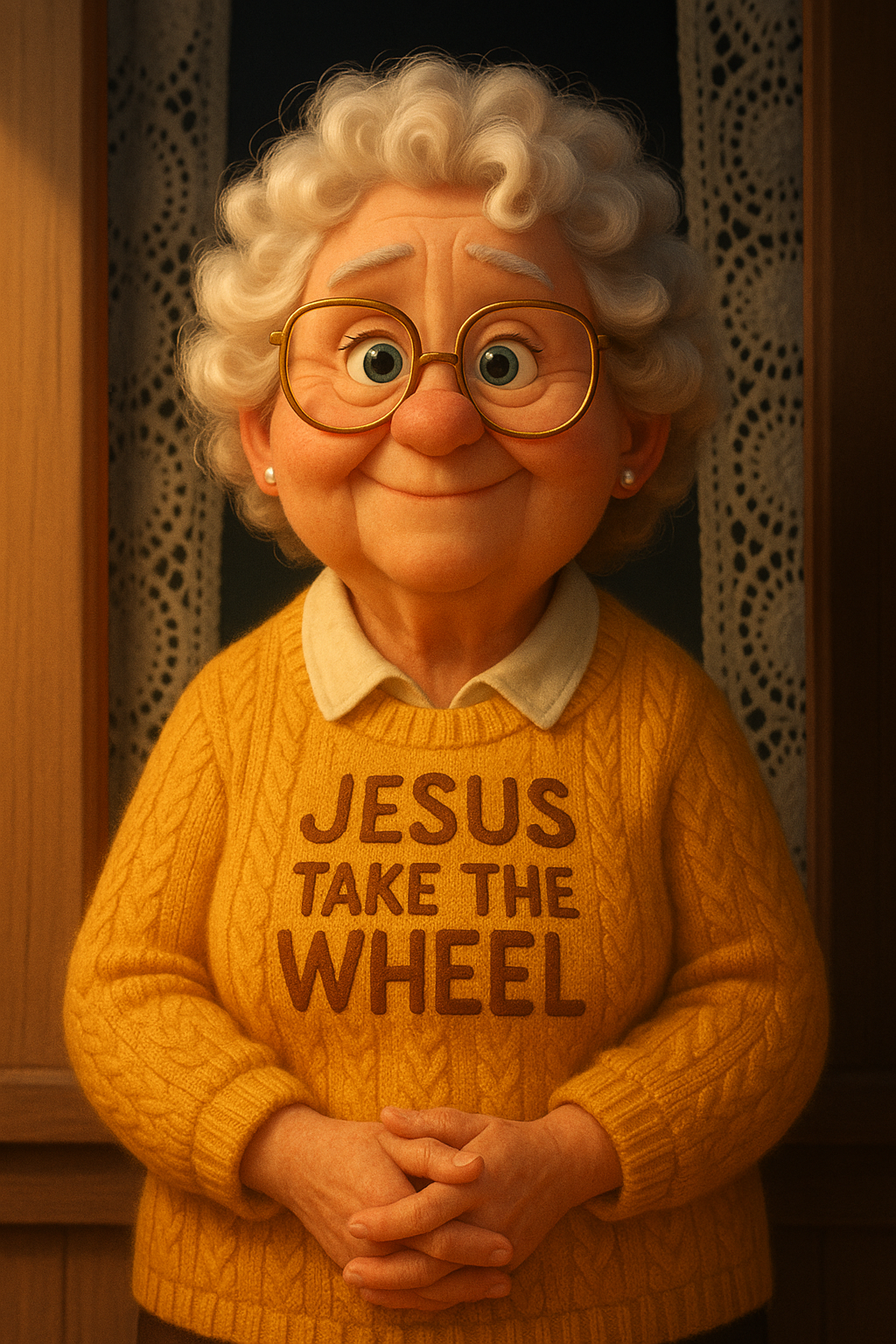
From behind crocheted doily curtains, Grandma Ruthie May waved like the American flag out front the house. Her cardigan read: Jesus, Take the Wheel (But Only if You’re Going to Joann’s). Her hair was curled into righteous ringlet submission. She believed in God, gravy, and good manners—in that order.
The doormat said Welcome Home. Unless you were Garrison, in which case it said Government Property—Do Not Trust. Lottie’s read Shoes Optional, Trauma Accepted. Preston’s glitched between Return on Investment and Mom’s Will Is Still Unsettled. Maggie’s just said Hi. Which felt just about right, for a five year old.
Maggie lingered in the doorway. The porch flexed, glitching like it couldn’t quite decide whose reality to resonate with. She took a breath, stepped inside, and the door groaned shut behind her.
The table had legs. Whether it could still hold this family together was less clear.
Ruthie May insisted it was the same table her great grandfather built by hand. She smoothed a placemat stitched with the Beatitudes and set down the turkey like it was part of a sacrament. “Smells like the Lord’s supper,” she smiled.
Lottie took a grounding breath and examined the turkey like a crime scene.
“That’s not food,” she scolded, pulling a glass dish from her woven basket, “Quinoa-stuffed peppers. Gluten and shame free!”
Garrison checked both dishes for microchips. “We’re just gonna eat government mystery meat under full surveillance lighting like I didn’t just pull my phone out of the freezer this morning?”
Preston’s fork was stainless steel and personally imported from somewhere with tax incentives. He refused to eat with anything labeled “community cutlery.” He’d already written off the cranberry sauce as a socialist condiment.
The turkey was tradition. But now it shimmered with the tension of truths.
To Ruthie May, it was golden brown and God approved. To Lottie, still not vegan. To Garrison, CIA-engineered tofu, worse than his war rations. To Preston, a tax deduction under “event catering.” And Maggie was able to see each one; exactly where they were at.
As plates were passed, the conversation tilted—literally.
The table cracked under the pressure as four worldviews collided across it.
“I just think,” Ruthie May began, “we need to get back to biblical values.”
“What values?” said Lottie. “The patriarchy?”
“Here we go,” Garrison muttered, pulling from his jacket a crumpled, coffee-stained pamphlet titled:Truths They Won’t Teach You in School (But Should): Volume VII – Moon Lies, and Fluoride Crimes.
Preston sighed into his imported linen napkin. “This is why generational wealth skips a generation.”
“Oh please,” Lottie snapped. “Some of us inherited trauma, not trust funds.”
Ruthie May folded her hands. “Lord Jesus, we thank you for gathering us here today—even the ones who believe in chakras and conspiracy theories—”
“Turkey can’t fix hypocrisy,” Lottie scoffed before she got to amen.
Everyone was shouting now—
scripture, studies, stones, and stocks.
The turkey vibrated like a summoned spirit.
Reality fractured.
Split along the seams of certainty.
Forks vanished like flow in a group chat.
Plates duplicated just to disagree.
One chair sprouted a second armrest, argued with itself, then disappeared in a poof of passive aggression.
No one noticed. Because when you’re sure you’re right, you don’t look for evidence. You turn up the volume.
Somewhere between the shouting and the turkey’s phase shift, Maggie’s chair lifted off the floor. She noticed. Of course she did. She didn’t speak much at these things—not because she didn’t have thoughts, but because she knew the rules: Adults didn’t take turns. They argue and fight. Maggie knew better than to hope. So she listened. And silently waited for the moment it would all fall apart—again.
Eventually, the shouting dissolved. Not from resolution, but exhaustion. No winner. No retreat. Just silence, like a power outage. The house, for even just a second, remembered how to be still.
“I remember the time Ruthie May dropped the lasagna in the driveway,” Lottie eventually offered, giggling at the recollection through her kombucha. “It slid right off the foil and into the gravel.”
Ruthie May added “That lasagna was blessed. Gravel or not, your grandpa still ate three helpings.”
Preston chuckled. “Was that before or after Garrison locked himself out wearing nothing but his cowboy boots?”
Even Garrison smiled. “I remember that, by god those were my very best cowboy boots, they don’t make em’ like that anymore.”
Something shifted.
The room held still, like it had taken a breath.
The chairs lined up.
The table held.
The turkey stopped shimmering.
Forks reappeared. Plates found peace.
Even the lighting normalized—suddenly warm, and not weaponized.
And for the first time all afternoon, they were all seeing the same thing.
No one argued.
No one corrected.
Maggie sat up straighter, heart thudding. Afraid to exhale. She knew it couldn’t last.
“Wait,” Preston argued. “That wasn’t Christmas. That was Easter.”
“No,” Ruthie May insisted firmly. “It was Christmas. I made my cranberry JellO cross.”
“Actually,” Lottie added, “I’m fairly certain it was vegan eggplant, not lasagna.”
A pause, and then again:
“Wait,” Preston argued. “That wasn’t Christmas. That was Easter.”
Maggie blinked. The voices were stuck. The script replayed, as if reality itself had hit repeat.
Maggie closed her eyes.
For a second, the house held them all.
But that second was gone.
The fracture returned.
The turkey flickered.
The chairs duplicated.
The table split in two.
No one noticed.
Except Maggie, of course she did.
That much remained.
The house still had shingles.